Our Impact Framework
People need to know what’s going on.
Every community runs on information. It is a public good, just like roads and schools. We need to know what our local governments are doing, if our water is safe, where to get help after a storm, and what our neighbors are worried about.
A news outlet can publish articles and some might call that impact, but really, it’s what people do with the information that matters. People are not generally tracking if their local outlet published more stories this year than the year before; what they do care about is whether the information that matters to them reaches them, and that they know what to do with it.
This framework shifts focus from what is produced to the way it is felt in the daily lives of the people our partners serve.
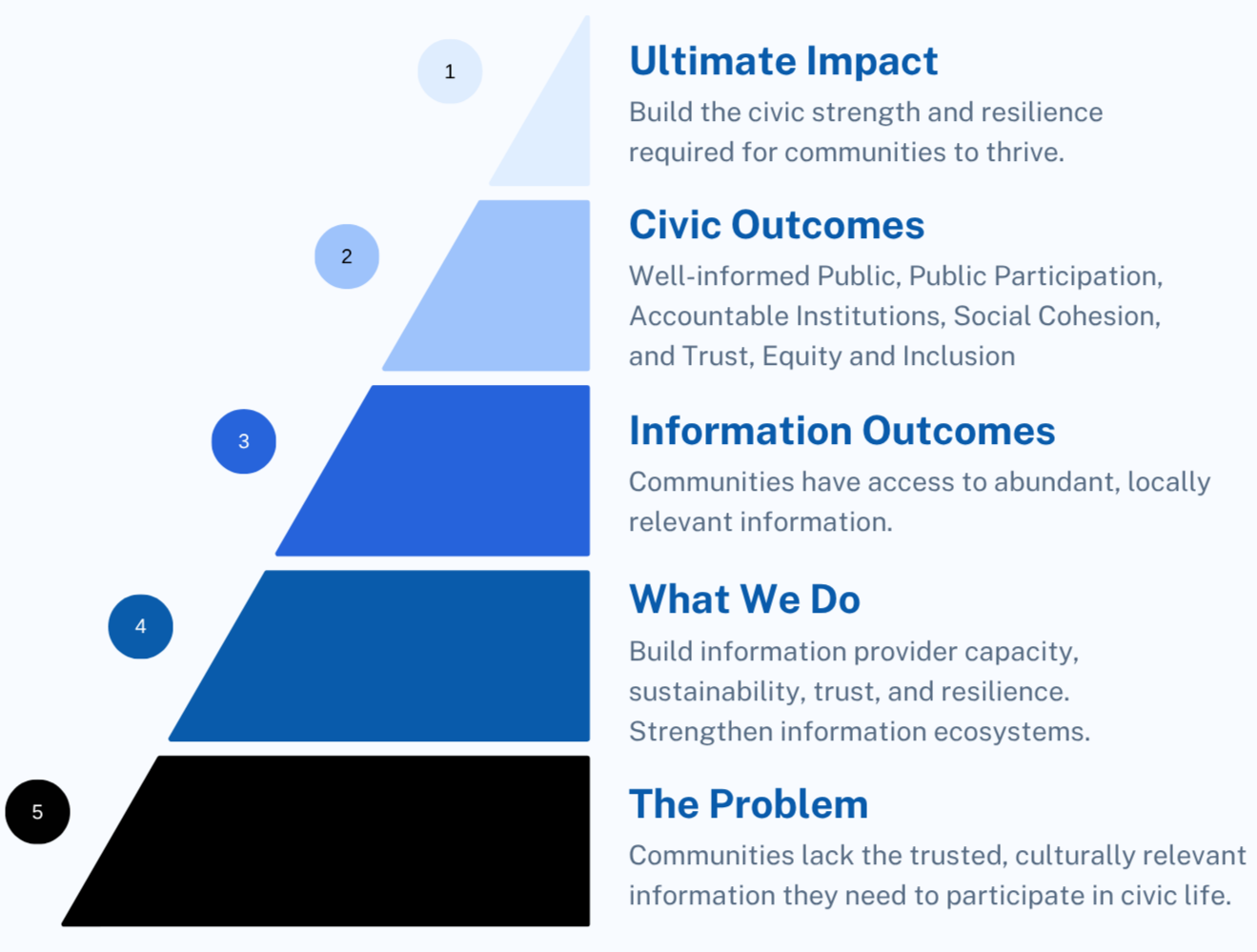
Five Pathways to Civic Strength
Our Theory of Change is simple: when communities can get information they trust, in a form they can use, they do more with it. They can solve problems, show up, and ask hard questions of the people making decisions. They get to know their neighbors.
Do this consistently over years, and a community gets stronger—and better able to handle what comes next. Health, safety, dignity, democracy: it all becomes more possible.
That’s what we call civic strength.
Internews follows five pathways to this end goal, with signals of change along the way.
1: Well Informed Public
People know what’s going on
WHAT HAPPENS: Someone covers the things that shape daily life. Complicated things are explained in plain language. This information actually reaches people where they’re already looking—social media, newsletters, print explainers.
WHAT CHANGES: People can act on things: claim services, meet deadlines, prepare for storms, weigh in on decisions. People draw from the same set of facts, even if they disagree on how they want to solve a problem.
-
When a Russian drone strike on a hydropower plant upstream in Ukraine polluted the Nistru river in March 2026, the city of Bălți, Moldova, 95,000 people, lost its water for five days, and nine passed before the water was confirmed safe to drink.
An Internews-supported outlet published where the working wells were and kept posting the water tank schedule, in which districts and at what times.
Residents found water and pushed the posts out through their own neighborhood chat groups. They used the comments to complain that deliveries were running late and nobody at the city could be reached. The outlet took that to the administration, which started publishing an accurate schedule.
2: Public Participation
People can take part
WHAT HAPPENS: Decision-making processes are communicated: when meetings happen, who is voting, how a community member can get involved. It reaches the people who are most affected by those decisions.
WHAT CHANGES: People show up to vote, testify, volunteer, and organize. The pathways to get involved are easy. People get used to raising their voice and giving feedback.
-
In Wamena, in Indonesia's Papua province, residents queued for hours for gasoline that was perpetually short—in a place where fuel governs whether you can work, travel or run a shop.
Across seven Indonesian provinces, Internews trained community members—not professional reporters—to cover the places they live. In Wamena, a community member interviewed people waiting in the queues, then convened a radio talk show that put their complaints directly to government and civil society representatives, and shared it afterward through a local YouTube channel.
Within a week the regent made surprise inspections of fuel distributors and the trade office rewrote the rules for the queue.
The same pattern repeated elsewhere: in Aceh, a citizen journalist's report on a university's failing facilities got the internet restored the next day and the classroom fans repaired inside a week; and in Jember, a mostly-women collective documented maternal health and domestic violence until a local advocacy group signed a formal agreement with the religious court on services for women.
3: Accountable Institutions
People hold leaders to account
WHAT HAPPENS: Promises get tracked, claims are double checked and challenged. Decisions being made in closed rooms become public. Budgets, spending, services, misconduct, and complaints are all transparent, and their complexities are communicated in a way people can follow.
WHAT CHANGES: People hold public systems and services to the standard they promised. People bring issues to the officials responsible, and those officials have to answer for it. Isolated complaints do not die alone: they are filed, investigations open, and leaders and their communities are in consistent conversation.
-
Uganda lost nearly a quarter of its tree cover between 2000 and 2020, and in Buikwe District the agency charged with protecting the forests was also issuing the permits that let them be cleared.
In 2024, with a grant from Internews’ Earth Journalism Network, journalist Culton Scovia went undercover with a drone and aired a three-part investigation on Luganda-language television showing the logging trucks and the paperwork behind them.
Two days later a Member of Parliament wrote to the Inspector General of Government citing the broadcast, an investigation opened, and Buikwe councillors moved their next council meeting into the clear-cut reserve itself to demand the forests stop being handed to outsiders.
4: Social Cohesion and Trust
Neighbors understand each other
WHAT HAPPENS: Stories highlight common ground instead of stoking division. Groups that usually only make the news when something goes wrong have their ordinary stories told, from their first-hand perspective. Rumors are corrected before they take off.
WHAT CHANGES: People get to know their neighbors, the struggles they have in common, and shared vision for their communities. People are less likely to turn against one another. They check a rumor before passing it on.
-
When the pandemic hit, Maritza Félix's mother was on the Mexican side of the U.S. border sending her prayers, memes, and cures every morning—some of which were myths being passed around WhatsApp.
In May 2020, Internews’ Listening Post Collective helped Félix open a WhatsApp group where people could ask questions and get verified answers, and it became a free hour of conversation every weekday across the Arizona–Sonora line. They covered the news, the myth of the day, and the border. Once a week an immigration lawyer or a psychologist or the Mexican consul dropped in. Then came a radio show, a newsletter, and a podcast.
Six years on, Conecta Arizona has long outgrown COVID. It's become a news service people talk back to, covering immigration, schools, money, and local politics for more than 100,000 people in two countries. People use it the way you use a neighbor: they bring a question about a marriage license or a vaccine or a deadline, they argue about the border and then about what to make for dinner. The ones who have been there a while, Félix says, now know each other beyond names and phone numbers.
5: Equity and Inclusion
Nobody gets left out
WHAT HAPPENS: Information reaches people in a language they speak, on the devices they own, at a cost they can afford. Reporting includes the perspectives of the people a story is actually about, not other voices talking for them. Coverage treats their inclusion as a gain for the whole community.
WHAT CHANGES: The people usually left out of decisions get a real say in them. The benefits they qualify for actually reach them.
-
Across Hopi land in Arizona, distance and thin infrastructure decided who received an emergency message and who didn’t.
In 2025, with support from Internews’ Listening Post Collective, KUYI Hopi Radio asked its own community how emergency information actually reaches them. They found that nearly half of residents access the internet through a single device, usually a phone, that many households have no reliable Wi-Fi, and that elders need information in the Hopi language.
The station took those findings to Hopi Law Enforcement, Emergency Medical Services and tribal leadership to build shared crisis protocols, with emergency messaging designed for a phone first.
How Do We Know It’s Working?
Output counts are the easiest measure of this work and the least informative: a partner can publish more than it did the year before without anything changing for the people it serves. Internews assesses its programs against three questions instead:
Did it reach people? Who saw or heard it, in which communities, in which language and format—and whether it actually mattered to them.
Did they use it? Did they make a decision, show up, get a service, solve a problem, or speak up?
Did anything change around them? Did an institution respond, policy or practice change, or community emerge stronger? Is it felt in the lives of the people most affected?